Home
Beqa Lagoon, Fiji, September / October 2008

Beqa Lagoon: Among the Apex Predators

A hush falls over Beqa Lagoon as bubbles drift toward the surface. Moments earlier, the reef crackled with sound; the percussion of feeding fish, the scrape of coral, and the low thrum of expectation. Then the water darkens. From the blue comes motion and mass; a ballet of power in which humans are minor characters. This is Fiji’s Beqa Lagoon, one of the few places on Earth where divers can share the water with the ocean’s most misunderstood hunters: sharks.

The Feed

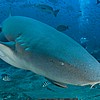
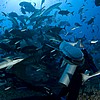
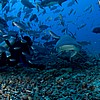
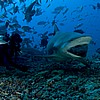
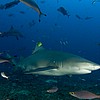
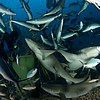
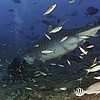
The feed begins with a flurry of movement. Sergeant majors, rainbow runners, and giant trevally surge forward, flashes of silver and yellow cutting through the haze. Nurse sharks sweep in low, their mouths questing through the sand. On the periphery, lemon and silvertip sharks circle with measured patience, while the blacktips and whitetips hang back in the shadows. The water vibrates with sound; the pulse of life condensed into a single reef slope.

036_BEQ10010689.JPG

A mass of fish twists upward, their mirrored flanks catching the light. It’s easy to be drawn into the spectacle, yet every diver here knows to stay alert. At Beqa, attention is survival and awe in equal measure.

020_BEQ09290347.JPG

The Arrival of Scarback

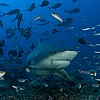
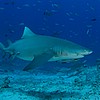
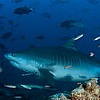
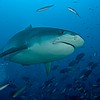
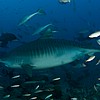
Then, silence. The reef’s chatter fades, and the smaller sharks melt into the blue. A shadow moves in with the confidence of command. Out of the haze appears a tiger shark, vast and deliberate. Her name is Scarback, known to local guides for the mark along her dorsal ridge. In person, she is both graceful and monumental, her stripes dark and distinct against her pale sides.

Her eyes are visible even through the filtered light; amber, calm, assessing. Sharks possess electroreceptors sensitive enough to detect the faint pulse of a human heartbeat. As she passes overhead, the sense of being seen, rather than merely watching, is unmistakable.

050_BEQ10010749.JPG

Perception and Reality

The Beqa shark dives have always stirred debate. Some question the ethics of feeding wild predators; others see it as one of the most powerful conservation tools in the Pacific. To witness a tiger or bull shark up close is to challenge decades of cultural mythology. These are not mindless killers, but complex, responsive creatures; apex regulators that maintain the balance of reef ecosystems.

Globally, over a hundred million sharks are killed each year. Many vanish unseen, taken for fins, bycatch, or through habitat loss. Since this article’s original writing in 2008, nations across the Pacific have responded by declaring vast shark sanctuaries; Palau, the Marshall Islands, French Polynesia; creating safe havens across millions of square kilometres. Yet despite these wins, industrial longlining and climate-driven shifts continue to pressure pelagic species across the tropics.

Community and Conservation

Beqa’s program remains a model of community-led stewardship. Local villages receive a levy from each dive, ensuring that the presence of sharks brings recurring economic value far beyond a one-time catch. A single live shark, returning year after year, is worth tens of thousands of dollars in tourism revenue; a stark contrast to the few hundred dollars its fins would fetch on the black market. Healthy sharks, healthy reefs, healthy communities.

The feeding practice itself is carefully managed. Tuna offcuts; by-products from local fish processing; are dispersed to sustain smaller reef fish as well as the sharks. The cycle nourishes the system rather than disrupting it. Long-term tagging studies have since shown that many of Beqa’s bull sharks travel astonishing distances, reappearing in places as far away as Australia’s Coral Sea. Their migrations link nations, ecosystems, and policies.

Reflections

Back on the boat, engines hum softly as Beqa fades into mist. Divers sit in quiet reflection, the surface calm after the storm below. The encounter lingers; not as adrenaline, but as understanding. To meet an apex predator on its own terms is to confront fear and replace it with respect. The tiger, the bull, the reef itself; they are threads in the same tapestry. Lose one, and the fabric weakens.

001_BEQ09290292.JPG 002_BEQ09290293.JPG 005_BEQ09290306.JPG 007_BEQ09290309.JPG 008_BEQ09290310.JPG
009_BEQ09290311.JPG 013_BEQ09290317.JPG 014_BEQ09290318.JPG 018_BEQ09290345.JPG 019_BEQ09290346.JPG
020_BEQ09290347.JPG 029_BEQ09290411.JPG 029a_BEQ10010713.JPG 032_BEQ10010675.JPG 036_BEQ10010689.JPG
042_BEQ10010736.jpg 044_BEQ10010740.jpg 049_BEQ10010748.jpg 050_BEQ10010749.JPG BEQ09300569.JPG
Copyright (c) Colin Gans. All rights reserved.
Reproducing any image  (in whole or  part) or text without expressed written consent violates copyright.
If you have any queries regarding the use of, or the licensing of images, please
email me.